
Turning parts of revolution: what a Pinacho lathe solves
The lathe is not the poor cousin of CNC: it is the right machine for a different kind of part. At MASA Mecanizados (Subirats, Barcelona) we turn on a Pinacho with 1.000 mm between centres, 430 mm swing over the bed and a 52 mm spindle bore. Here is what comes out better turned, the tolerances we work to and how a part of revolution is made.
What a part of revolution is (and why it goes on the lathe)
A part of revolution is one whose surface is generated by rotating a profile around an axis. A shaft, a bush, a pinion, a washer, a cone, a spindle: they are all the same problem solved by spinning the part instead of moving the tool.
When a customer tells us «I need a steel shaft», the useful question is not whether it gets milled or turned, but whether the part is cylindrical. If it is, the lathe is quicker to set up, cheaper and more accurate on diameter. With our CNC machining we always justify the process with geometry, never out of habit.
Our Pinacho lathe, in numbers
The real capacity of the machine
| Data | Value | What it allows |
|---|---|---|
| Distance between centres | 1.000 mm | Long parts: shafts, spindles and bars that do not fit in a machining centre |
| Swing over the bed | 430 mm | Maximum diameter you can machine by rotating the part |
| Spindle bore | 52 mm | Maximum bar diameter that fits in the spindle |
| Typical tolerances | h6 on diameters · H7 on bores | Verified on the actual part before delivery |
The 430 mm swing over the bed is the figure that decides many parts: it is the maximum diameter you can work on. And the 52 mm spindle bore sets the bar diameter that fits in the spindle, in other words where the material comes from.
What comes out better turned than milled
The parts that go on the lathe in our workshop
- Long shafts and spindles: up to 1.000 mm between centres, with the part supported on the centres so it does not deflect while being cut.
- Bushes and sleeves: turned on the outside and bored on the inside, with the internal diameter controlled at the same time as the external one.
- Gears and pinions: profile and diameter come out of the same operation, with the same coaxiality.
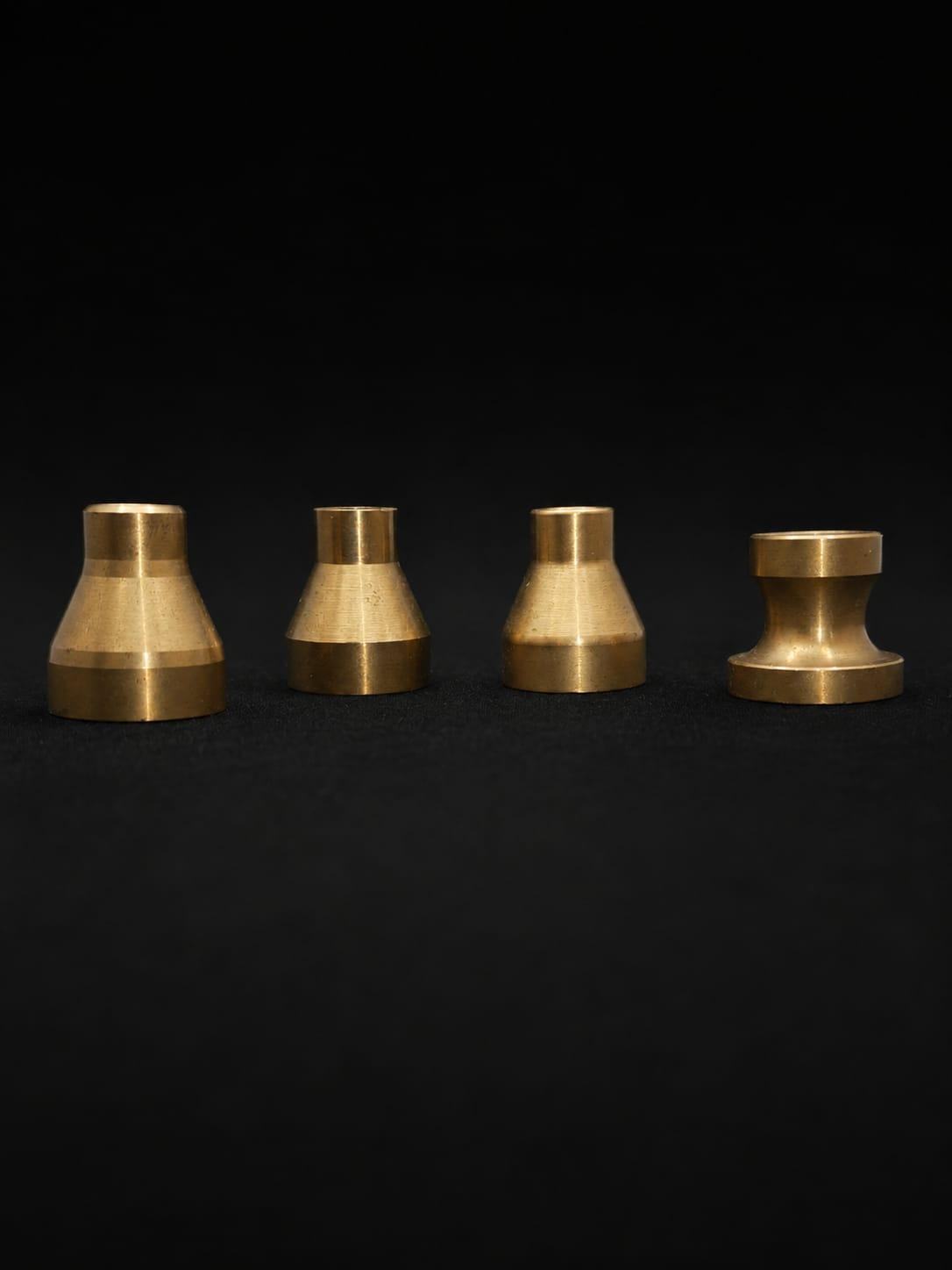
- Brass adapters: cones and reductions for couplings, in a soft material that machines easily.
- Parts with a thread: thread and diameter turned in the same setup, without re-centring the part between operations.
- Urgent spares: when a machine is down and the shaft is needed today.
Tolerances: h6 on the diameter, H7 on the bore
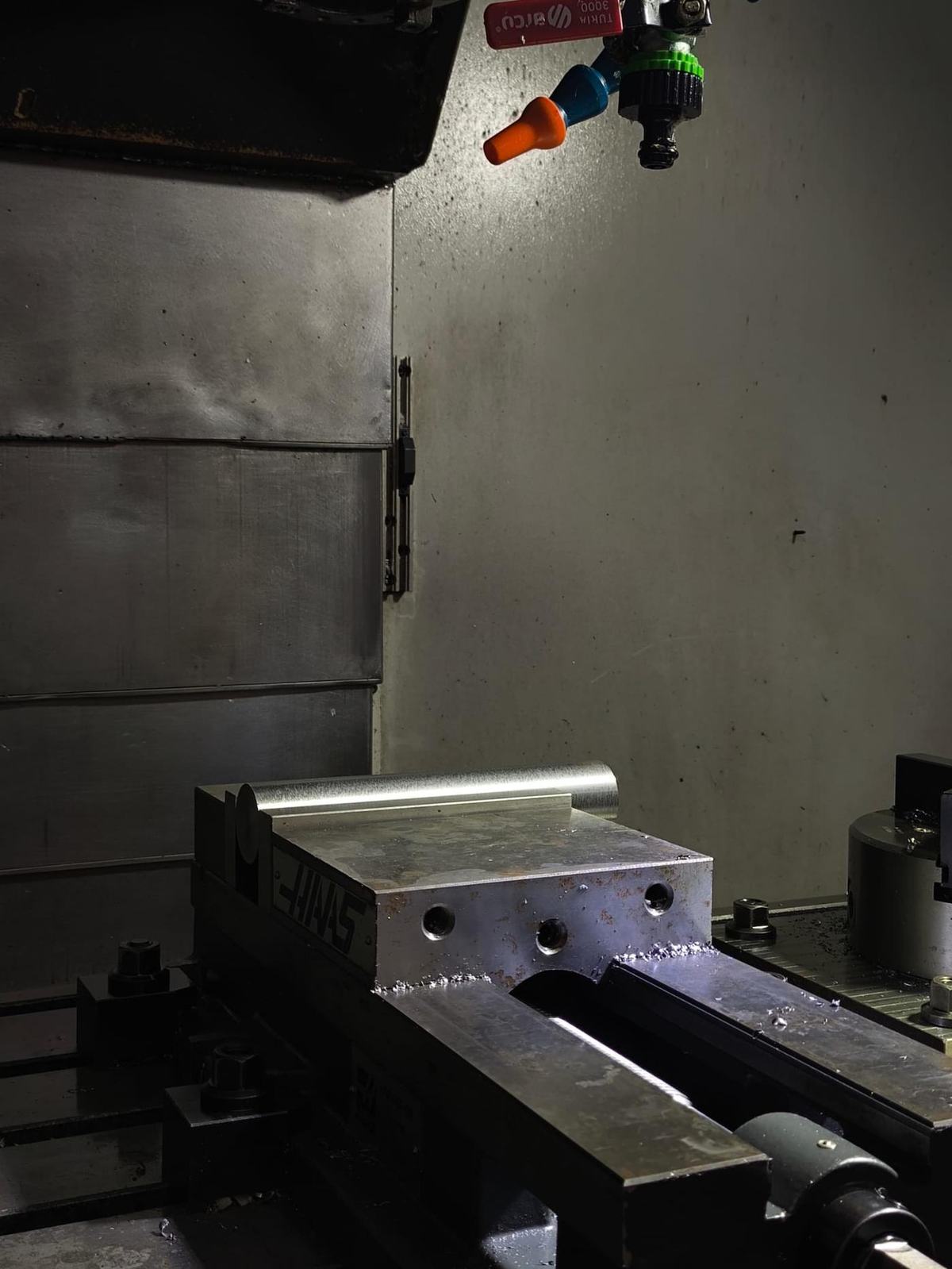
In turning we regularly work to h6 on diameters and H7 on bores. The difference between the two is not marketing: h6 is a tolerance on the external diameter (the shaft that goes into a hole) and H7 is on the hole (the bush that receives it). Together they are what is called an H7 fit, and it is what makes the part fit first time.
Turning helps because the cut is perpendicular to the axis: the tool enters radially and the diameter is directly controlled by the machine's own feed. In milling, the diameter is the result of moving the tool on two axes, and there the dimension takes more work.
How we verify the diameter
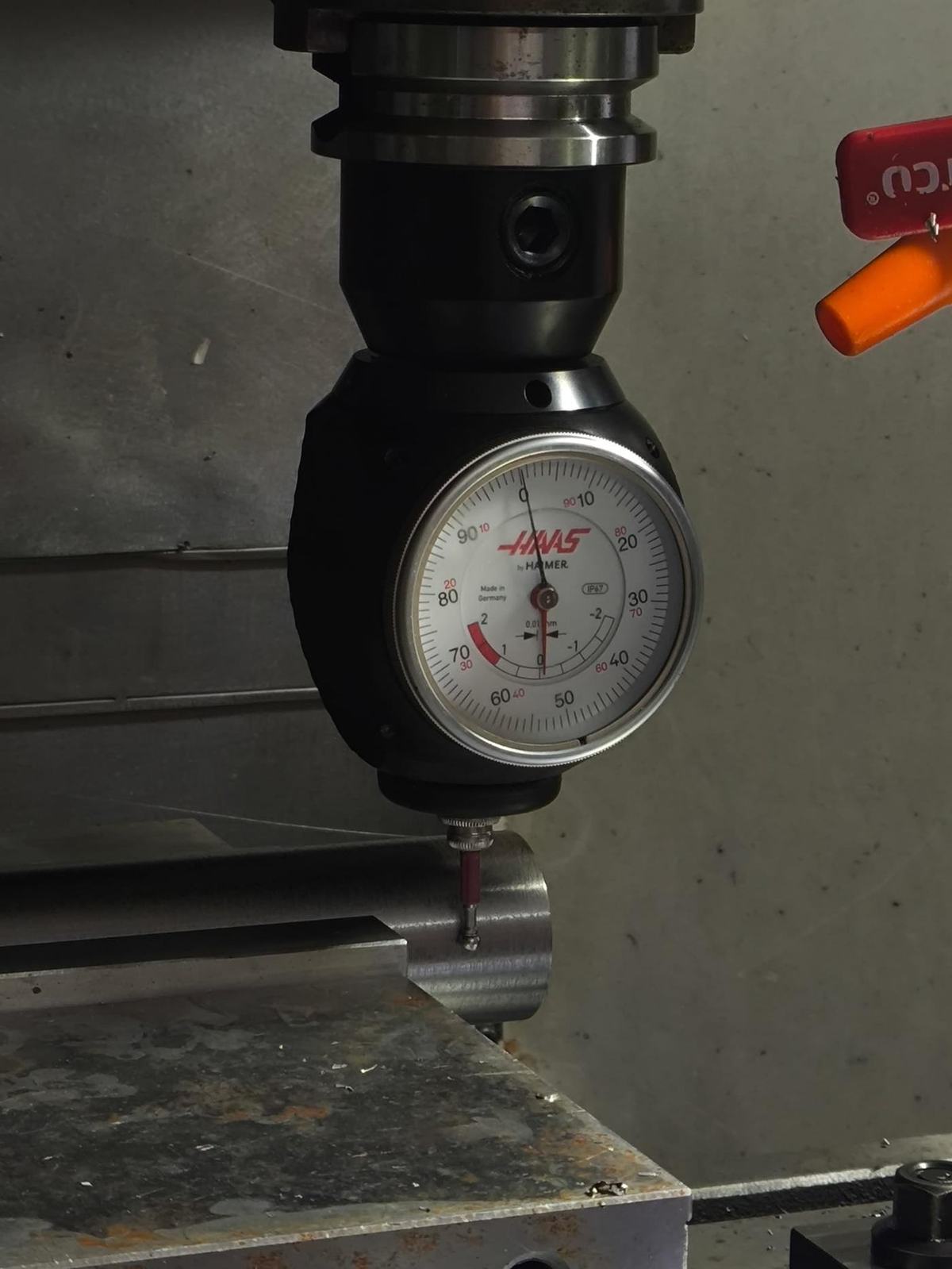
Measuring is not the last step, it is part of the process. On the lathe itself, with the part mounted, we check the diameter with a dial indicator and with callipers. Only after that check is the part removed, cleaned and delivered.
Why it matters: a part that almost meets the tolerance is useless. An h6 shaft that ends up half a tenth of a millimetre oversize goes from fitting first time to having to be forced, and that half of a tenth ends up as clearance, vibration or early failure of the bore itself.
When turning is not the answer
Some parts are not bodies of revolution and therefore do not go on the lathe: boxes, pockets, plates with holes on different faces, robotic gripper structures or precision tooling. That is what the CNC machining centre is for, with 1.050 × 500 × 500 mm of travel.
And there are mixed parts, the most common kind in a workshop like ours: a turned shaft with one end milled flat, or a turned bush with a cross hole. In that case the right process is to do both operations in the same workshop, so the part never moves between machines and loses its datum.
How we work with your part
The process, from start to finish
- You send the drawing (PDF or STEP) or simply the dimensions and a photo of the part.
- We give you price, material and lead time in under 24 hours. If the material is available, the lead time is confirmed in the same reply.
- We turn the part, with the process that suits it: roughing, finishing, boring, threading.
- We verify the dimensions on the actual part and deliver it with the agreed finish.
Right now we have free capacity with no queue, so urgent parts are processed with very short lead times. If you want the detail of this service, it is on our conventional turning page.
Turning in Subirats, for the Penedès and Barcelona
We are at Carrer de la Plana, 6, 08739 Subirats (Barcelona), minutes from Vilafranca, Sant Sadurní or Martorell, and we serve the whole Penedès region and the Barcelona metropolitan area. If you have a drawing, a 3D file or even a sample part you would like assessed, send it over and we will put a proposal to you with no commitment.
Got a part to turn?
At MASA Mecanizados we tell you whether your part is a body of revolution and which process it needs. Price and lead time within 24 hours of receiving the drawing.
Request a quote